Megathrust Explained: What It Is and What It Means for Indonesia

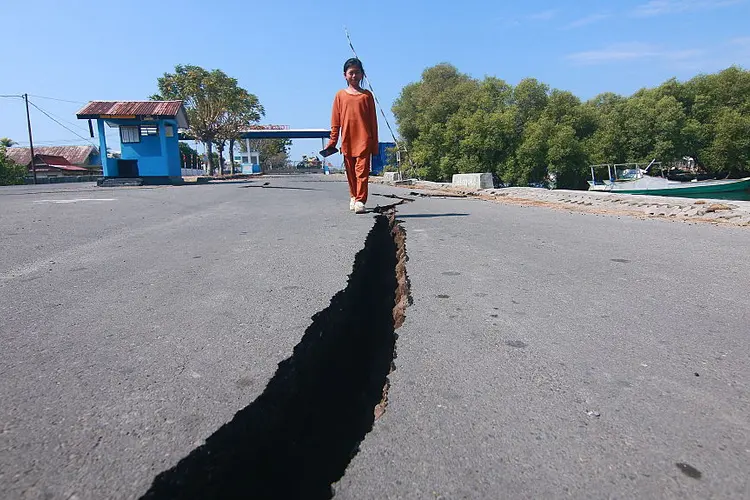
Megathrust earthquakes may sound alarming, but understanding the science can help you stay informed and prepared.
The term megathrust has become increasingly familiar in discussions about earthquakes in Indonesia. But what exactly is a megathrust, and why does it matter for people living in an earthquake-prone country?
A megathrust is a large fault found at a subduction zone, where one tectonic plate moves beneath another. Because these faults can extend for hundreds of kilometers, movement along them can produce some of the largest earthquakes on Earth.
However, understanding Indonesia’s megathrust zones should not be confused with predicting when a major earthquake will happen. Indonesia’s Meteorology, Climatology, and Geophysical Agency (BMKG) has emphasized that discussions about megathrust potential are not earthquake forecasts or warnings that a major event is about to occur. Scientists currently cannot accurately determine when, where, and how strong a future earthquake will be.
Instead, learning about megathrusts can help us better understand Indonesia’s geological environment and the importance of earthquake preparedness.
Also read: Indonesian Food Guide: 12 Must-Try Indonesian Dishes for Expats and Where to Find Them
What Is a Megathrust?
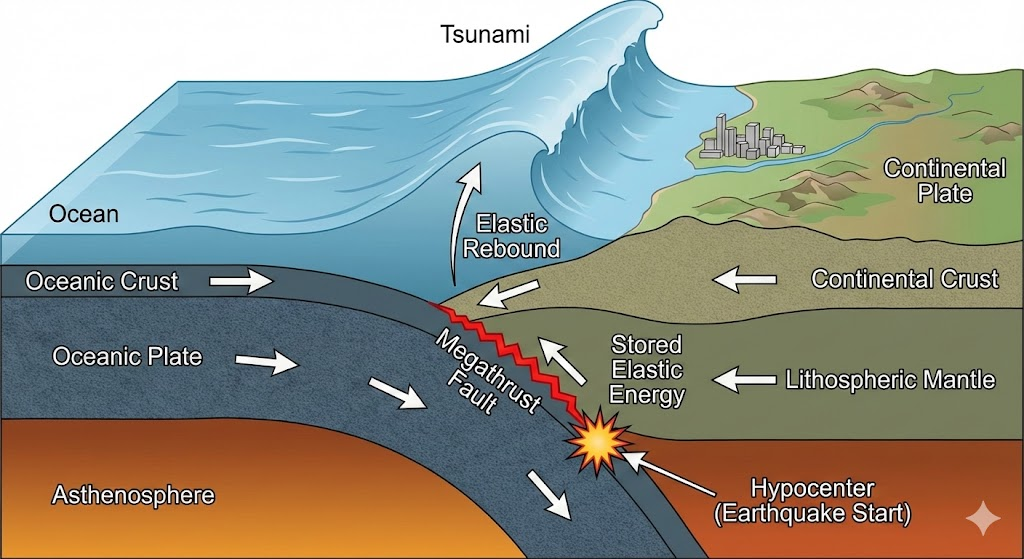
A megathrust is a type of fault associated with a subduction zone. A subduction zone forms where two tectonic plates converge and one plate is forced beneath the other.
As the plates move, the boundary between them may become locked because of friction. Stress can gradually accumulate along the fault. When the accumulated stress overcomes the strength of the locked section, the fault can suddenly slip, releasing energy as seismic waves and causing an earthquake.
Because megathrust faults can cover very large areas, earthquakes associated with them can also be extremely powerful. The 2004 Sumatra-Andaman earthquake, for example, occurred along the megathrust beneath the western part of Sumatra and the Andaman Islands and generated a devastating tsunami.
This is why megathrusts are an important subject in earthquake science. They help scientists understand how tectonic movement can affect communities located near active subduction zones.
How Does a Megathrust Earthquake Happen?
The process can be simplified into several stages:
1. Tectonic plates converge
Two tectonic plates move toward each other at a subduction zone.
2. One plate moves beneath another
The denser plate is gradually pushed beneath the overriding plate.
3. The fault becomes locked
Friction can prevent the plates from moving smoothly along part of their boundary.
4. Stress accumulates
As plate movement continues, energy and stress build up along the locked section.
5. The fault slips
When the accumulated stress exceeds the strength of the fault, the locked section can rupture and release energy as an earthquake.
Not every earthquake in a subduction zone is a megathrust earthquake. Earthquakes can also occur within the subducting plate, in the overriding plate, or in other parts of the tectonic system.
Why Does Indonesia Have Megathrust Zones?
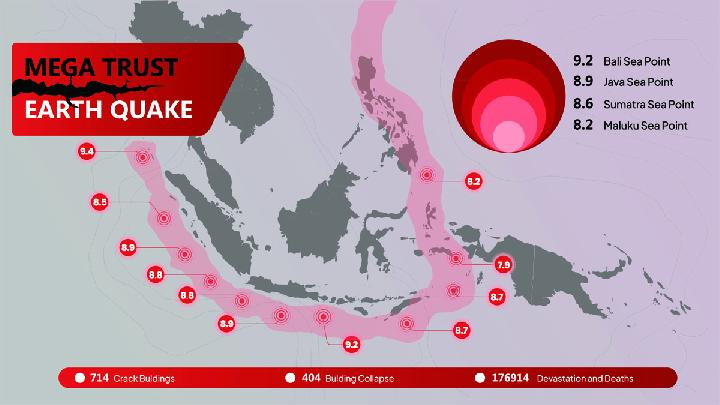
Indonesia is located in a complex and highly active tectonic region, where several major tectonic plates interact. Its geological setting includes multiple subduction zones, where one tectonic plate moves beneath another, making earthquakes a natural part of the country’s geological environment.
One of the best-known examples is the Sunda subduction zone, which extends along the western and southern parts of Indonesia. The 2004 Sumatra-Andaman earthquake occurred within this broader subduction system.
Two areas that have received particular scientific attention are the Sunda Strait Megathrust and the Mentawai-Siberut Megathrust. BMKG has identified both as areas associated with a seismic gap, referring to sections of an earthquake-prone zone that have not experienced a major earthquake for a long period based on historical records. The last major earthquakes associated with the Sunda Strait and Mentawai-Siberut segments are recorded in 1757 and 1797, respectively.
Earthquake-source modeling also estimates potential maximum magnitudes for different megathrust segments. In the 2017 Indonesian Earthquake Source and Hazard Map (PusGeN), the maximum modeled magnitude is M8.7 for the Sunda Strait Megathrust and M8.9 for the Mentawai-Siberut Megathrust. These figures represent modeled earthquake potential, not predictions that earthquakes of these magnitudes will occur or indications of when they might happen.
Beyond these two areas, Indonesia has numerous other megathrust segments stretching from western Sumatra to eastern Indonesia. The PusGeN segmentation includes areas such as:
- Aceh-Andaman
- Nias-Simeulue
- Mentawai-Pagai
- Enggano
- West-Central Java
- East Java
- Sumba
- North Sulawesi
- The Philippine segment
- Papua.
The presence of a seismic gap does not mean that a major earthquake is about to happen. BMKG emphasizes that current science and technology cannot accurately predict when, where, or how large an earthquake will be. Instead, identifying these areas helps scientists and authorities better understand earthquake hazards and strengthen preparedness and mitigation efforts.
What Is a Seismic Gap?
A seismic gap generally refers to an area along an earthquake-prone zone where a major earthquake has not occurred for a relatively long period compared with surrounding areas or historical records. Scientists can study these areas as part of broader earthquake hazard assessments. Research published through BMKG, for example, notes that identifying seismic gaps can help support earthquake monitoring, tsunami preparedness, infrastructure planning, and spatial planning.
However, a seismic gap should not be interpreted as a countdown to an earthquake. BMKG has specifically clarified that references to the Sunda Strait and Mentawai-Siberut megathrust areas as seismic gaps are not predictions that a major earthquake will happen soon. The agency has also stated that current science and technology cannot accurately predict the exact time, location, and magnitude of an earthquake.
This distinction is important: earthquake potential describes what could happen, while earthquake prediction would require knowing when and where it will happen.
Can a Megathrust Earthquake Cause a Tsunami?
A megathrust earthquake can generate a tsunami, but not every megathrust earthquake will produce one. Tsunamis can occur when an earthquake causes significant vertical movement of the seafloor, displacing a large volume of water. Underwater landslides can also generate tsunamis.
This means the relationship is not simply: megathrust earthquake = tsunami. Instead, whether an earthquake generates a tsunami depends on factors such as the earthquake’s location, depth, fault movement, and the amount and direction of seafloor displacement.
The 2004 Sumatra-Andaman earthquake is a major example of how movement along a subduction-zone fault can generate a tsunami affecting coastal communities across a wide area.
What Does Megathrust Risk Mean for Cities?
The potential impact of an earthquake varies significantly from one location to another. Factors can include the earthquake’s magnitude and depth, distance from the source, local geological conditions, building construction, population density, and the level of preparedness.
This is why earthquake preparedness is relevant even for people who do not live directly above a megathrust zone. For urban residents, preparedness can begin with simple steps such as understanding building evacuation procedures, identifying safer areas indoors, securing heavy furniture, and knowing where emergency exits are located.
For coastal communities, tsunami awareness is particularly important. Knowing evacuation routes and understanding local tsunami warnings can help people respond more effectively if an official warning is issued.
How to Prepare for an Earthquake

Earthquake preparedness does not have to be complicated. A few practical measures can make it easier to respond during an emergency.
Before an earthquake
- Learn the emergency procedures for your home, apartment, dormitory, or workplace.
- Identify safer areas inside the building, away from windows and objects that could fall.
- Secure heavy furniture and other objects that could topple during strong shaking.
- Prepare a disaster emergency bag (tas siaga bencana) with essentials such as drinking water, food, a flashlight, first-aid supplies, medicines, a power bank, and important documents.
- Keep important documents and essential items accessible.
- Know the evacuation routes and emergency assembly points in your building.
During an earthquake
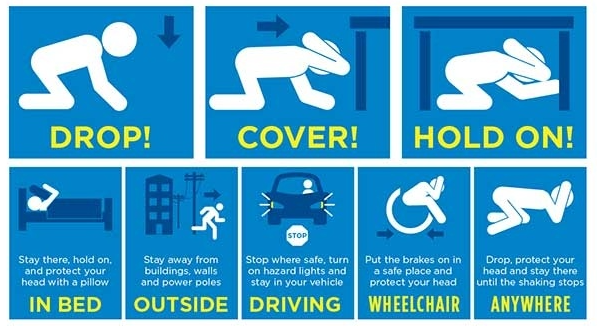
A widely used approach is Drop, Cover, and Hold On. Get down, take cover under sturdy furniture if possible, and hold on until the shaking stops.
Stay away from windows, glass, and objects that could fall. If you are inside a building, avoid rushing outside while strong shaking is occurring unless there is an immediate danger that requires evacuation.
After an earthquake
Check yourself and others for injuries, remain alert for hazards, and follow instructions from authorities. Aftershocks can occur following a significant earthquake, so continue following official information.
If you are in a coastal area and experience a strong or long-lasting earthquake, pay close attention to official tsunami information and local evacuation instructions.
How Does Indonesia Monitor Earthquakes and Tsunamis?
Indonesia has systems and institutions dedicated to monitoring earthquakes and providing information about potential tsunami hazards. BMKG monitors seismic activity and provides earthquake information and tsunami early warnings.
Preparedness also involves more than technology. Public awareness, safe buildings, evacuation planning, and regular emergency exercises all contribute to community resilience. In 2025, for example, Indonesian authorities conducted a national preparedness exercise involving a simulated megathrust earthquake and tsunami scenario. The exercise was designed as a preparedness activity rather than a prediction of an actual event.
For residents, one of the simplest preparedness measures is knowing where to obtain reliable information. During an earthquake or tsunami emergency, official information from BMKG and local authorities should take priority over unverified messages circulating on social media.
Frequently Asked Questions About Megathrust
Is a megathrust earthquake going to happen soon?
There is currently no scientific method that can accurately predict the exact time, location, and magnitude of a future earthquake. The existence of a megathrust zone indicates earthquake potential, not that an earthquake is about to occur.
Is Indonesia at risk of megathrust earthquakes?
Indonesia has several active subduction zones and earthquake-source areas, so understanding earthquake hazards and preparedness is important. However, the presence of these zones does not indicate when a particular earthquake will occur.
Can a megathrust earthquake cause a tsunami?
Yes, some megathrust earthquakes can generate tsunamis when they cause significant vertical displacement of the seafloor. However, not every megathrust earthquake produces a tsunami.
What is a seismic gap?
A seismic gap is an area along an earthquake-prone zone where a major earthquake has not occurred for a relatively long period based on available geological or historical information. It can be useful for hazard assessment, but it does not provide an exact prediction of when an earthquake will occur.
Can scientists predict a megathrust earthquake?
Scientists cannot currently predict the exact date, location, or magnitude of an earthquake. However, they can study historical earthquake records, tectonic movement, fault characteristics, geological evidence, and seismic activity to better understand earthquake hazards. This research supports hazard assessments and preparedness planning, but it cannot provide a precise timetable for the next major earthquake.
What should I do during an earthquake?
If you are indoors: Drop, Cover, and Hold On. Stay away from windows and objects that could fall, and follow your building’s emergency procedures. After the shaking stops, follow official instructions and remain alert for aftershocks.
Understanding Megathrusts Without the Fear
Now that you understand what a megathrust is and how to prepare for an earthquake, the most important thing is to stay informed without unnecessary worry. Keep your disaster emergency bag (tas siaga bencana) somewhere easy to reach, such as beside your bed or near an exit, and make sure everyone in your household knows where it is.
Stay updated through official information from BMKG and follow guidance from local authorities during an earthquake or tsunami warning. Being prepared is not about predicting when an earthquake will happen—it is about knowing what to do if one does.
For people living in Indonesia’s cities, earthquake preparedness can be part of everyday responsible living. Knowing your building’s emergency procedures, keeping essential supplies accessible, understanding evacuation routes, and following reliable information sources are practical steps that can strengthen individual and community resilience.
Rather than treating the word “megathrust” as a reason to panic, it is more useful to see it as an opportunity to learn about earthquake science, understand local risks, and become better prepared.
Learning about megathrust earthquakes is not about predicting when the next major earthquake will happen. It is about understanding Indonesia’s geological environment and knowing how to prepare.
If you’re planning to relocate to Indonesia, finding a comfortable and secure place to live is an important part of settling in. Rukita offers coliving spaces and apartments in more than 24 cities across Indonesia, with fully furnished rooms and shared facilities designed to make everyday living more convenient and hassle-free.
Ready to find your new home?
Don’t forget to download Rukita app via Google Play Store or App Store or visit www.rukita.co. Follow Rukita’s Instagram account @rukita_indo, X/Twitter account @rukita_id, and TikTok account @rukita_id to get the most recent information and other interesting deals!
Bagikan artikel ini